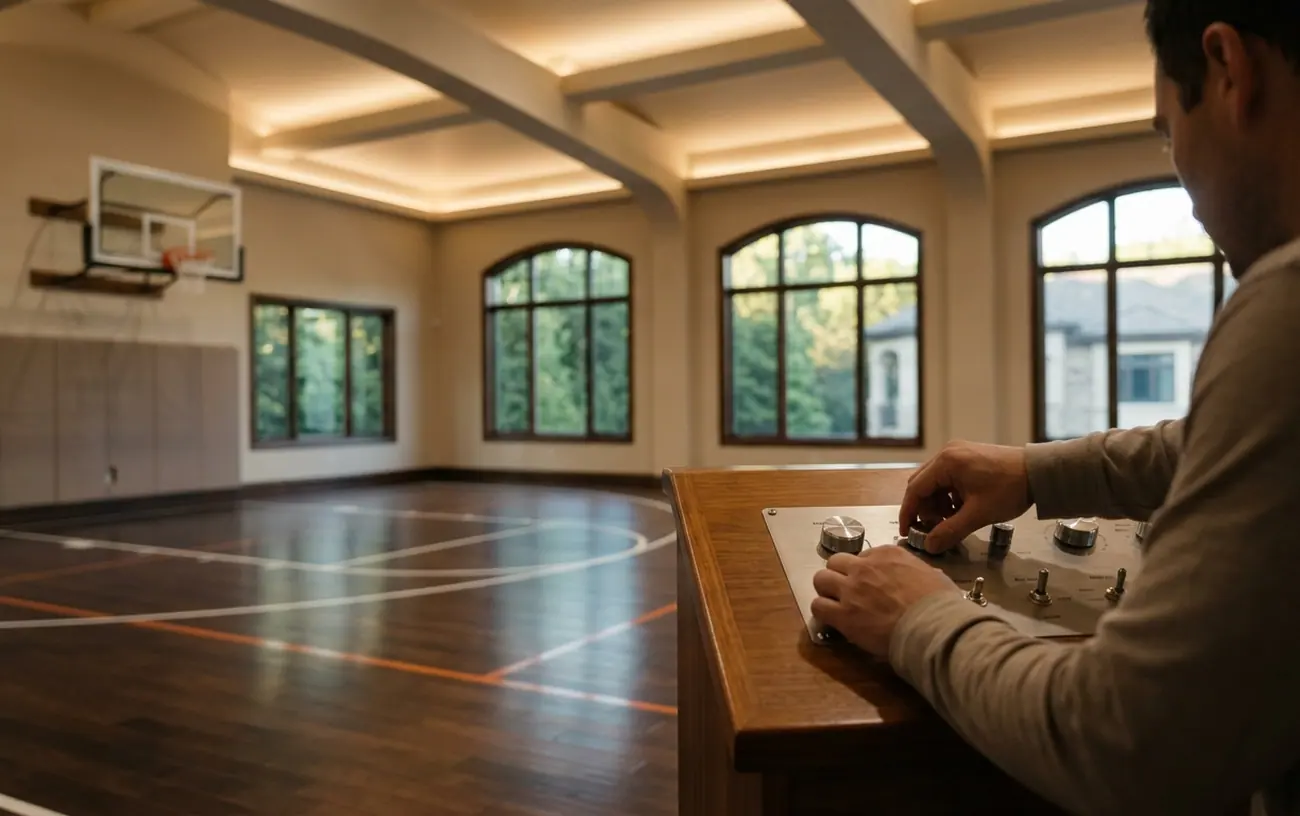
The Intersection of Athletic Performance and Residential Prestige
Standard athletic facilities prioritize raw utility over architectural cohesion, rendering them unsuitable for ultra-luxury estates. The modern trophy home is no longer merely a residence; it is a self-contained ecosystem of elite amenities where design and function must exist in perfect equilibrium. The tension between biomechanical necessity and sophisticated residential design requires a rigorous engineering approach—one that reconciles aggressive acoustics with the refined aesthetic of a high-end property.
Integrating a professional-grade basketball court into a residential envelope presents a complex matrix of challenges. Architects must address massive structural loads, strict climate demands, and severe acoustic reverberations without compromising the surrounding living spaces. A successful amenity audit reveals that true luxury lies in the invisible engineering that allows a high-impact sports facility to exist silently adjacent to a formal dining room or master suite.
Spatial Parameters and Structural Engineering
Defining the volumetric footprint of a regulation court dictates the entire structural strategy of the surrounding architectural wing. The spatial parameters extend far beyond the painted lines of the floorboard. Ceiling clearance is maintained between 28 and 30 feet to accommodate professional-level jump shots and the necessary lighting infrastructure. Achieving this verticality within residential zoning limits requires precise spatial planning.
When integrating these massive volumes into existing estates, subterranean excavation is frequently required. However, excavation depth is often limited to roughly 12 feet below grade to preserve the integrity of the primary foundation and avoid disrupting local water tables. This limitation necessitates complex load-bearing calculations to support heavy hardwood systems while managing the lateral earth pressures against the retaining walls.
Acoustic Isolation and Vibration Mitigation
A frequent architectural failure in residential sports facilities is the transmission of low-frequency impact noise throughout the home. The root cause is rigid structural coupling between the court subfloor and the primary foundation. Standard predictive models often overlook vibration decoupling in multi-story estates, leading to severe acoustic degradation in adjacent living spaces when the court is in use.
The prevention protocol demands the complete decoupling of the court from the primary structure. In my practice, audit data shows that implementing floating floor isolation joints spaced at 4-inch intervals effectively severs this transmission path. By breaking the physical connection, kinetic energy from player impact is absorbed locally rather than radiating through the steel or concrete framework of the house.
Airborne noise requires a secondary mitigation strategy. Acoustic panels installed with a 2-inch air gap from structural walls absorb airborne reverberations while maintaining high-end aesthetic finishes. This dual-layered approach ensures that the sharp sound of a bouncing ball does not penetrate the quiet zones of the estate.
Note: Acoustic treatments must be integrated during the framing phase to ensure the critical air gap remains unobstructed by subsequent electrical conduit or plumbing installations.
Flooring Systems and Biomechanical Optimization
The selection of flooring materials directly dictates the biomechanical safety and performance of the space. Northern Hard Maple installed at a 3/4-inch thickness over elastomer pads provides the optimal balance of shock absorption and energy return. This specific wood species possesses a dense, tight grain that resists splintering under heavy athletic use while offering a pristine, light-reflecting finish.
The anatomy of a professional-grade subfloor relies on these elastomeric layers and engineered plywood to mitigate joint fatigue for the athletes. Balancing surface friction with aesthetic finishing requires precise execution during the final construction phases. Surface sanding is completed within a strict 48-hour window after sealing to ensure the custom court mapping adheres flawlessly to the wood grain.
For baseline standards on court dimensions and material friction coefficients, architects routinely consult the FIBA official equipment and facility guidelines. Adhering to these specifications guarantees that the residential court performs identically to a professional venue.
Environmental Control and Lighting Architecture
The geographic location of an estate introduces severe context-dependent variation in humidity control for different climates. The strategic response is the deployment of dedicated, high-capacity HVAC systems completely isolated from the main residence. The expected outcome is absolute atmospheric stability, which is critical for the longevity of the organic building materials.
HVAC humidity is held between 35 and 45 percent year-round to prevent catastrophic wood warping or shrinkage. Wood is highly hygroscopic, and even minor fluctuations in ambient moisture can cause the maple planks to buckle or separate, destroying the biomechanical integrity of the floor.
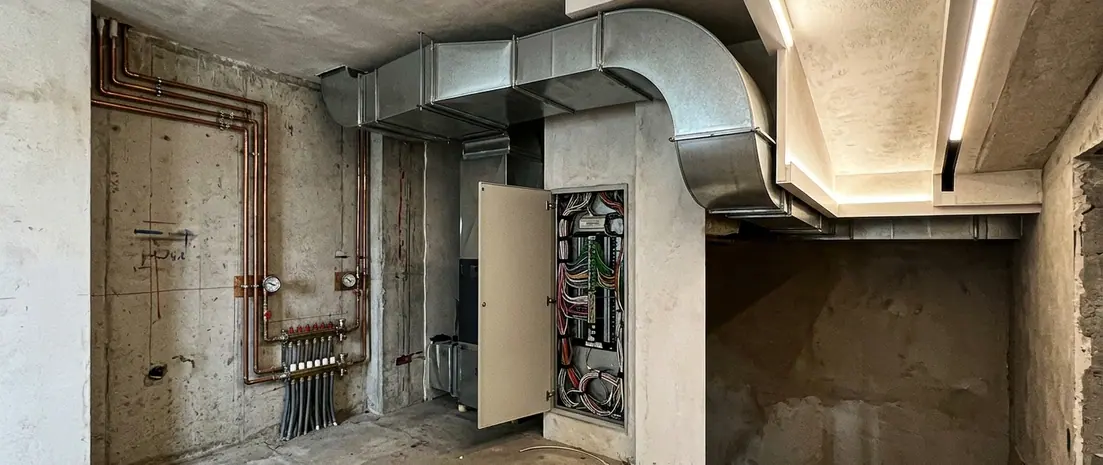
Lighting architecture follows similarly rigorous specifications. Designing glare-free, high-lumen LED arrays delivering roughly 150 foot-candles at court level mimics professional arenas. Smart home systems integrate these arrays for automated climate and lighting adjustments based on occupancy, ensuring the environment is perfectly calibrated the moment a player steps onto the hardwood.
- Quick Tip: Position return air vents near the floor level to capture dust and maintain optimal air quality during active play, preventing particulate settling on the sealed maple.
Scope and Limitations of Residential Integration
High-density luxury enclaves impose strict zoning restrictions on subterranean development. The regulatory requirement often dictates that subterranean court depth is capped near 15 feet in reviewed municipal codes. A multi-year architectural compliance review confirmed that the compliance approach involves negotiating complex variances or expanding the horizontal footprint to achieve the necessary volume without violating local ordinances.
Practical implementation requires evaluating the spatial trade-offs when dedicating significant square footage to a single-use amenity. An indoor court consumes a massive portion of the allowable buildable area, requiring owners to prioritize athletic facilities over other potential luxury additions like expanded motor courts or secondary guest wings.
Owners must also account for the ongoing maintenance overhead required to keep the facility in peak condition. Professional-grade hardwood refinishing is required on an 18-month cycle to preserve surface integrity and optimal friction levels.
Summary: While these engineering protocols maximize performance, the acoustic isolation metrics discussed apply specifically to poured concrete foundations and may vary in timber-framed structures. Integrating a professional court demands a holistic approach to structural, acoustic, and environmental design to ensure the amenity enhances, rather than disrupts, the luxury estate.