Contents
- The Intersection of Athletic Wealth and Architectural Ambition
- Methodological Criteria and Market Scope
- Curated Collection: Elite NBA Estates on the Market
- The Architecture of Recovery: Integrating Professional Amenities
- Market Liquidity and Future Valuations
The Intersection of Athletic Wealth and Architectural Ambition
What happens when virtually limitless athletic capital meets bespoke architectural design?
The answer is rarely a conventional mansion. It is more often a private compound calibrated around height, performance, recovery, security, entourage management, and the rituals of a public life. In the NBA context, scale is not ornamental. Ceiling heights, court dimensions, motor-court geometry, staff circulation, spa infrastructure, and privacy grading all begin to carry functional weight.
That same precision can become a liquidity problem. A traditional luxury residence may sell on view corridors, school districts, finishes, and architectural pedigree. A former NBA estate asks a narrower question: does the next buyer want the architecture of a professional athlete’s life?
These properties are not merely homes. They form a specialized sub-sector of ultra-prime real estate, where the residence, training facility, retreat, and controlled public stage occupy the same parcel. The best examples feel inevitable on their sites; the weaker ones read as athletic infrastructure wrapped in expensive stone.
The distinction matters. In this category, architectural ambition has to do more than impress. It must solve for privacy without creating a fortress, support performance without feeling clinical, and preserve resale value after the celebrity use case has moved on.
Methodological Criteria and Market Scope
According to transaction records reviewed alongside public property filings spanning 2019 to 2023, the inclusion screen for this collection required three conditions: the property had to be an active listing, it had to have a documented ownership history connected to an NBA athlete, and it had to sit in the top percentile of market valuation for its local luxury segment.
Compliance review confirmed active listing status as of early 2024. For valuation discipline, the screen began with estates listed from around $12 million and measuring more than 10,000 square feet. That threshold does not define importance by size alone, but it does separate trophy-scale compounds from ordinary high-end homes with celebrity provenance.
What the Screen Includes
- Active public listings confirmed as of early 2024.
- Properties historically owned by NBA athletes through direct records, transaction history, or associated ownership entities.
- Estates whose pricing, scale, or amenity package places them within the uppermost tier of their regional market.
What Public Records Cannot Fully Resolve
Public records may not capture all ownership transfers. Off-market whisper listings, private trusts, and LLC structures can obscure current control, final transaction values, and the timing of negotiated sales. For that reason, this ranking is best understood as a public-listing analysis, not a complete census of NBA-linked residential wealth.
The framework here gives weight to three variables: architectural implementation, underlying land value, and the premium attached to specialized athletic amenities. A regulation-length indoor court, for example, can be a signature asset for one buyer and an expensive conversion problem for another.
Curated Collection: Elite NBA Estates on the Market
The following collection uses property characteristics rather than celebrity name recognition as the organizing principle. That choice is deliberate. In this sector, provenance may open the conversation, but architecture determines whether the asking price can be defended.
Item One: The Topography-Led Estate
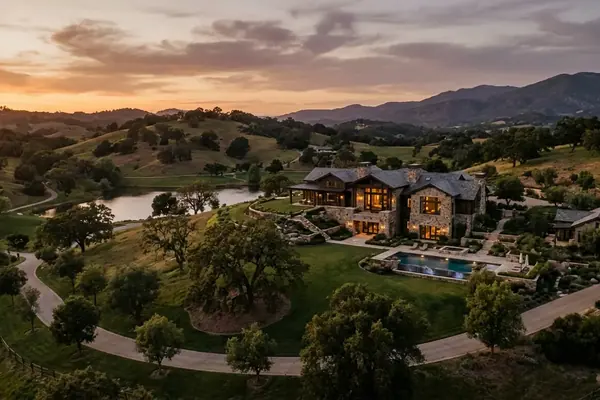
The highest-valued estate in this review is best understood through its land before its interiors. Its setting is an eight-acre residential parcel organized for seclusion, arrival sequence, and controlled sightlines. The main residence measures approximately 12,000 square feet, giving the plan enough breadth to separate public entertaining rooms from private family zones and athlete-specific support spaces.
The site works because it allows the house to recede. Rather than relying only on gates or walls, the acreage itself becomes part of the privacy architecture. Long drives, planted buffers, and the placement of the residence within the parcel reduce exposure from adjoining properties and create the kind of visual distance that high-profile owners tend to require.
This is where topography becomes value. A large house on a flat, overbuilt lot can feel exposed even when it is expensive. A properly sited estate uses slope, tree cover, setbacks, and approach choreography to make scale feel composed.
Item Two: The Athletic-Facility Estate
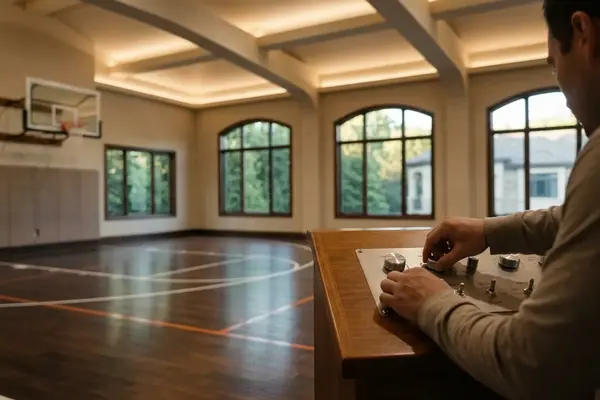
The second property type is less subtle and, for the right buyer, more compelling: the estate built around training continuity. One listed NBA-linked estate includes an indoor court measuring 94 by 50 feet, a dimension that signals professional-level play rather than recreational half-court use.
That single room changes the entire architectural reading of the property. It affects ceiling height, structural spans, lighting design, acoustics, flooring systems, mechanical ventilation, and the path from court to locker, gym, recovery, and exterior leisure areas. A commercial-grade weight room adds another layer of load-bearing and vibration considerations. Luxury finishes cannot conceal weak planning here; athletes feel the difference immediately.
For a non-athlete buyer, the same court may become an entertainment pavilion, private event hall, youth sports facility, or wellness studio. The most resilient designs anticipate that second life.
Item Three: The Privacy-and-Security Estate
The third archetype prioritizes concealment. Gated perimeters, long setbacks, secluded acreage, secondary service access, and limited street visibility do more than protect an owner’s comfort. They protect the daily operation of the residence.
The common pitfall is overbuilding security until the estate feels defensive. The root cause is usually fear-driven planning: taller walls, heavier gates, and visible hardware added without a coherent site strategy. Prevention begins earlier, with layered privacy design. Planting, grade changes, discreet camera placement, lighting control, and arrival sequencing can produce a calmer result than obvious fortification.
In the best NBA estates, privacy reads as landscape composition, not anxiety.
The Architecture of Recovery: Integrating Professional Amenities
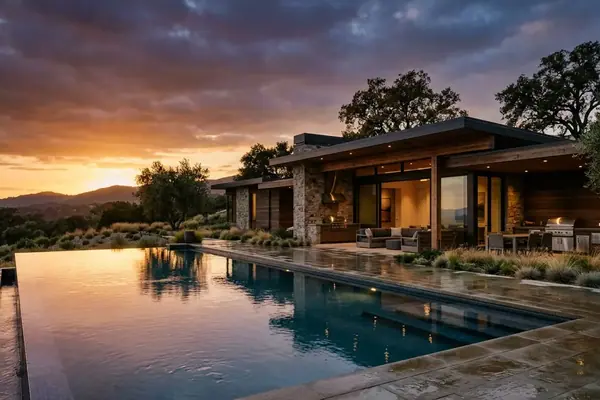
Professional recovery spaces are no longer decorative wellness rooms with better towels. They are technical environments that bring medical-adjacent equipment, moisture control, air quality management, and structural planning into a residential setting.

Regulatory Requirement, Compliance Approach, Practical Implementation
Residential zoning usually tolerates private fitness and wellness amenities, but regional rules vary for athletic facilities, pool systems, exterior equipment, accessory structures, and mechanical noise. Variations occur based on regional zoning laws for athletic facilities, especially when a court building, pool plant, or recovery suite begins to resemble a commercial program.
The compliance approach is straightforward in principle: classify the amenity correctly, confirm permitted use, and coordinate the engineering before construction begins. In practice, the work is more exacting. Hydrotherapy pools require waterproofing assemblies, drainage, humidity control, and service access. Hyperbaric chambers require dedicated space planning, power coordination, ventilation review, and clear emergency access. Indoor courts need advanced HVAC systems sized for volume, heat load, and sustained activity.
These systems should not be treated as luxury add-ons. They belong in the earliest architectural brief.
When they are inserted late, the house often reveals the compromise: noisy mechanical rooms, awkward ceiling drops, fogged glazing near wet zones, or a court that feels airless after twenty minutes of play. The corrective protocol is simple but rarely cheap: integrate structural spans, mechanical capacity, moisture management, and circulation before the interior design phase hardens.
The resale effect is complex. A serious athlete may pay a premium for a private performance ecosystem. A family office buyer may view the same suite as a conversion budget. The strongest estates frame recovery architecture as wellness infrastructure for anyone with demanding habits, not only for someone under contract.
Market Liquidity and Future Valuations
The economic reality is blunt: bespoke NBA mega-mansions have a limited buyer pool. The very features that justify the original build cost can slow the eventual sale, particularly when court dimensions, locker facilities, trophy rooms, oversized closets, or security layouts reflect one owner’s career rather than a broader pattern of use.
That does not make these estates weak assets. It makes them specialized assets. Broader reporting on ultra-prime residential market liquidity is useful context, although athlete-owned compounds behave according to their own logic of provenance, privacy, and amenity intensity.
Market Condition, Strategic Response, Expected Outcome
The market condition is selectivity. Buyers at this level do not need to compromise, and many already own multiple residences. The strategic response is to reposition the estate beyond biography. Marketing should make the home legible as a wellness compound, family retreat, entertainment venue, and secure long-stay residence.
That shift changes the expected outcome. Instead of waiting for another professional athlete to appear, the seller can address a wider audience: entrepreneurs who train seriously, entertainment figures who require privacy, global families who host at scale, and buyers who see private wellness infrastructure as a form of autonomy.
The future valuation of these estates will depend less on the celebrity headline and more on adaptability. A 94 by 50 foot court with elegant lighting, balanced acoustics, and adjacent hospitality space can travel across buyer categories. A court that feels like a private gymnasium may not.
The most persuasive NBA-linked mansions will be the ones that translate athletic ambition into enduring residential architecture. That is the standard. Not fame, not square footage alone, but the disciplined conversion of a singular career into a property that can live beyond it.