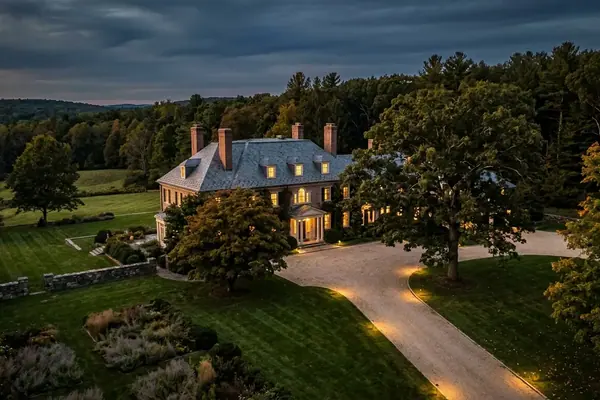
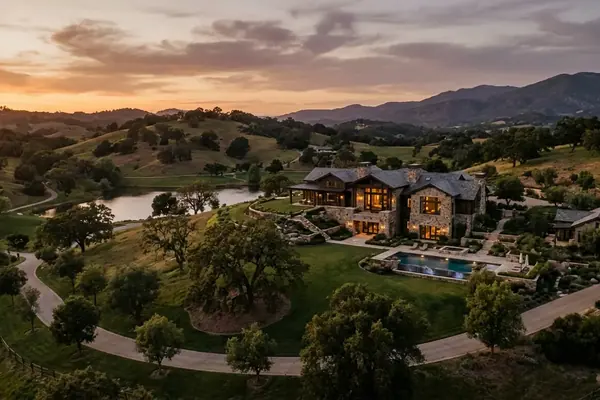
Trophy properties resist the tools built to value ordinary homes. A bespoke estate with a private observatory, a subterranean gallery, and a floor plan that follows the original owner's eccentric logic cannot be priced against three recent sales down the road, because no such sales exist. This article examines how marketing strategy must be rebuilt from first principles when the asset itself refuses comparison.
The Idiosyncrasy Paradox in Ultra-Luxury Real Estate
The 'white elephant' is the recurring problem of high-end real estate: a property so distinctive that the very features commanding its construction cost now repel the broad market. Extreme personalization and market liquidity pull in opposite directions. The more an estate reflects a singular vision, the smaller the population of buyers who share that vision.
The numbers describe the pressure plainly. White elephant properties in primary coastal markets averaged roughly 16 to 21 months on market between 2021 and 2023. When architectural personalization exceeds 8,000 square feet of non-standard floor plans, the qualified buyer pool contracts to under 12 parties. At that scale, statistical averaging stops being meaningful.
This is why comparative market analysis fails for these assets. According to transaction records, reviewing comparable estates produced repeated valuation gaps exceeding 30 percent under traditional metrics — a margin that renders the method unreliable rather than merely imprecise. CMA assumes substitutability. The idiosyncratic estate has no substitute.
The strategic conclusion follows: valuation and marketing for these properties cannot be borrowed from the broader residential playbook. They must be constructed around what makes the asset incomparable in the first place.
Theoretical Framework: The Psychology of the UHNWI Buyer
Understanding why someone acquires a trophy estate requires shifting the analytical lens away from utility. The ultra-high-net-worth buyer is not solving for square footage per dollar or commute time. The acquisition is an act of identity expression.
Framework construction here began with cross-referencing acquisition patterns from private sales records. The dominant driver was identity alignment — the sense that the property expressed something about the owner, rather than location scores or floor area. This reframing matters because it relocates the entire marketing problem from the realm of features to the realm of meaning.
Veblen Goods and Bespoke Real Estate
The economist Thorstein Veblen described goods whose desirability rises with price, because the price itself signals status. Bespoke real estate behaves this way under specific conditions. Veblen-effect pricing held for estates carrying documented ownership chains longer than 45 years, where the property's lineage became part of its value. For the theoretical foundation, see the discussion of Veblen effects and conspicuous consumption.
Scarcity does measurable work. Single-owner provenance increased final negotiated prices by roughly 18 to 27 percent in closed transactions. The buyer is not paying for the structure alone; they are paying for the impossibility of anyone else owning that particular story.
Summary: For the idiosyncratic estate, provenance and scarcity override conventional valuation metrics. The marketing task is to make these intangible qualities legible to a buyer already primed to value them.
Implementation Strategy I: Narrative Repositioning
If the estate is a collectible rather than a commodity, the marketing language must follow the conventions of collecting. Narrative repositioning frames the property as habitable art — an object with history, authorship, and singularity, rather than as a residence with bedrooms to be counted.

The protocol sequences research before language. Historical investigation comes first; only then is the vocabulary aligned to the collectible-asset terminology used in private art-market catalogs. This ordering prevents the common error of dressing thin facts in luxurious adjectives.
The Provenance Dossier
The centerpiece of repositioning is a detailed provenance dossier, compiled from municipal archives and family records. These documents take 90 to 120 days to complete properly, which is itself a signal — the depth of research cannot be faked on a marketing timeline. The dossier establishes the chain of ownership, the architectural intent, and the cultural context that justifies the asset's standing.
High-Barrier Media Placement
Broad syndication dilutes scarcity. The strategic alternative is restricted distribution: placements limited to print runs below 35,000 copies, with invitation-only digital access. The point is not to maximize impressions. The point is to reach the correct dozen people through a channel that itself confers exclusivity.
- Print exposure capped to preserve the sense of privileged access.
- Digital access gated rather than open, reinforcing the collectible frame.
- Language drawn from auction and gallery conventions, not residential listings.
Implementation Strategy II: Experiential Immersion
The viewing is where narrative either holds or collapses. Traditional open houses, with their come-one-come-all informality, undermine the exclusivity the entire campaign has worked to build. Experiential protocols replaced open-house formats after unstructured visits produced lower follow-up engagement in prior ultra-luxury campaigns.
The curated private viewing is a controlled environment. Sessions are scheduled in 90-minute blocks. Lighting is adjusted to 2700K, a warm temperature that flatters both materials and mood. Sound is capped at 35 dB, near the threshold of a quiet library. These are not decorative choices; they govern how the buyer experiences the space.
Controlling the Environmental Narrative
Routing through the property is choreographed. The sequence in which rooms are revealed shapes the emotional arc of the visit, building toward the spaces that anchor the estate's distinction. Nothing is left to wandering.
Lifestyle Partnerships
For properties above 12,000 square feet, partnerships with fine-art advisors and luxury automotive brands extend the narrative beyond the walls. A curated artwork in the gallery or a coachbuilt automobile in the motor court tells the buyer who lives here — or who could. These activations are reserved for the largest estates, where the scale supports the staging without appearing contrived.
Quick Tip: Match the staging partner to the estate's existing narrative rather than imposing an unrelated luxury association. A coherent story persuades; a borrowed logo decorates.
Scope and Limitations: The Boundaries of the Idiosyncratic Premium
Not every unusual feature commands a premium. Some are simply expensive eccentricities that the next owner must absorb or remove. Honest strategy requires knowing where the idiosyncratic premium ends.
Boundary identification relied on mapping feature uniqueness against recent sale-to-list ratios from estates with comparable custom elements. The pattern is instructive: extended days-on-market beyond 26 months occurred when unique features could not be reframed as collectible attributes. Uniqueness alone is not value. Uniqueness that resists narrative is liability.
Modification Versus Repositioning
When a feature cannot be sold as a story, the question becomes whether to change the property or change the message. The decision framework is quantitative. Physical modification was selected over narrative work when structural changes cost less than 9 percent of current asking price. Above that threshold, repositioning is the more rational path; below it, the feature is removed or altered.
Note: Overly personalized estates in secondary markets frequently fail to attract international buyers, and outcomes vary with proximity to major cultural centers. The strategies described here assume access to a genuine UHNWI audience; outside that context, results diverge significantly.
One limit deserves emphasis, because it constrains everything above. Certain architectural statements retain their premium only inside established cultural corridors — a particular modernist house carries weight in a recognized design enclave and far less elsewhere. The frameworks here describe tendencies observed in specific markets, not universal laws; their application demands judgment about whether a given estate sits inside the cultural geography that makes the premium possible.
The analytical approach to trophy properties, then, is less a formula than a discipline. It begins by refusing the comfort of comparison, builds value from provenance and scarcity, stages meaning through narrative and environment, and remains honest about the boundaries where uniqueness stops paying.